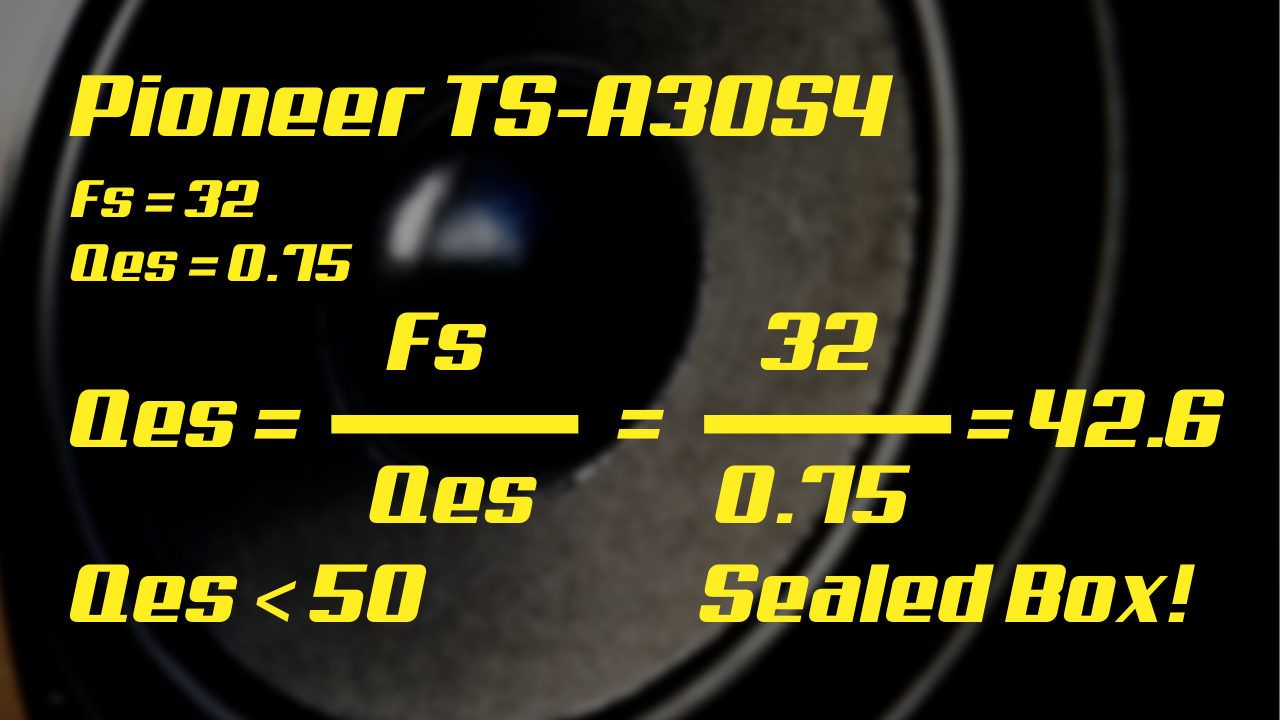
The Efficiency Bandwidth Product is a computation to determine if a driver can be used in a ported or sealed enclosure.
If the Efficiency Bandwidth Product is below 50, that driver is best suited to a sealed enclosure.
If the Efficiency Bandwidth Product is above 100, that driver is best suited to a ported enclosure.
If the Efficiency Bandwidth Product is between 50 and 100, that driver will work in both a sealed enclosure and a ported enclosure.
What do we need to know to compute the Efficiency Bandwidth Product?
In order to compute the Efficiency Bandwidth Product, we need to know the driver's Fs and Qes. These are Thiele-Small Parameters you can find either on the spec sheet in your driver's manual, or found on the manufacturer's website.
How do we Compute for the Efficiency Bandwidth Product?
We compute Efficiency Bandwidth Product by dividing Fs by Qes.
Can you give some Examples to solve for Efficiency Bandwidth Product?
Efficiency Bandwidth Product for DS18 EXL-12.2D
Efficiency Bandwidth Product for Pioneer TS-A30S4
Efficiency Bandwidth Product for Dayton Audio Classic DCS305
Are you looking for a signal to tell you the gain is set? Do you want a buzzer that says "stop turning that knob? The simplest and least expensive way to set your gains is with a piezo tweeter.
Setting the amplifier gain matches the input of the amplifier to the output of the deck. We know the amplifier gain is too high when the amplifier output distorts.
It is difficult for your ears to discern clean sound vs distorted sounds. Discerning distortion is even more difficult at high volumes. You will need a tool to help set your amplifier gains.
There are expensive tools that help with this process. They use a blinking light to tell you when the amplifier output distorts. These tools are great if you set gains on amplifiers day in and day out.
But do you need an expensive tool? What if you could use an inexpensive speaker that buzzes when the amplifier distorts? The answer is a piezo.
What is a Piezo?
A piezo is a crystal that gets excited when a voltage passes through it. Engineers figured out how to convert these crystals into speakers. Piezo tweeters were common in the 80s and 90s in full range car stereo boxes. Those piezo tweeters loaded into a horn assembly to play loud. Companies like Kicker and MTX would pair these with woofers for a full range car audio box.
One of the properties of a piezo tweeter is that it is capacitative. That means the circuit resistance increases as the frequency decreases. That means a piezo tweeter blocks bass frequencies without a crossover circuit.
When an amplifier begins to distort or clip, the amplifier produces harmonic frequencies. A harmonic frequency is a multiplication of the target frequency. An example of a clipped signal is the "crunch" of an electric guitar's over-drive circuit. While that is great for rock and metal music, it is terrible for your subwoofer and your amplifier.
So if we're playing a 40hz "natural" tone, the harmonics will be 80hz, 160hz, 320hz, 640hz, and so on. These harmonics will play through the piezo and sound like an audible "buzz". The piezo will play the buzz but not the main tone.
Youtuber Taylor Fade of Everyday Audios compares the piezo tweeter to the SMD AMM-1. You can hear the piezo buzz when Taylor pushes the amplifier to distortion. The light on the AMM-1 also turns on when the amplifier distorts. Give it a watch:
Here are the steps to setting amplifier gain with a piezo tweeter
Unplug the speaker
Plug in the piezo at the amplifier speaker leads
Turn down the gain
Play a 40hz tone
turn the deck to 90% volume
turn up the gain until the piezo clicks and back it off one notch.
Tell your friends not to touch the gain knob. Ever.
Final Thoughts
Setting your gain is a necessary chore to ensure you are sending a clean signal to your subwoofer. One should make sure the gain is set in a way that will not damage speakers. If you have an amplifier that is more powerful than your speakers rating, you can use a digital multi-meter to set the gains.