Wednesday, February 22, 2023

Why does streaming music sound awful in my system?

Why does streaming music sound awful when compared to physical media or a downloaded track? You connect the phone to the stereo, fire up your favorite music streaming service, find your favorite album and push play.

You're disappointed because the musical experience is as flat as the front of my khakis.

The reason it sounds flat is that it has been flattened out. The music amplitude has been constrained to a specific dynamic range. Loud peaks are quieted down and soft passages are pumped up. Streaming services call this "normalization".

Normalization is turned on by default because most of the audience streams from a mobile device to a small Bluetooth speaker or a stock car stereo for background noise.

Which is fine if you just want background noise.

If you're like me and want to experience the music, you need to experience the highs and the lows, the quiet and the loud. You gotta have all of that to really feel the music.

You need to turn off Normalization.

To turn off Normalization, grab your phone. Open your streaming service. Find the settings. Scroll down until you find normalization. Set it to off. 

Now that your streaming service isn't constraining your music, go rediscover your favorite albums all over again.


Monday, February 20, 2023

Why does your calculator produce different results than other calculators?


It's been a while since I posted a video. I've been busy. 

Over the summer of 2022 a user of the website reached out to me and asked why subwoofer.tools produced a different set of overall outside dimensions than another online calculator. The user asked which calculator produced the "correct" results.

The good news is, both calculators are technically correct. The best kind of correct. 

In this video, I explain why both calculators are correct, and I also provide a little bit of insight into a new feature I've been working on for the box calculator. Hint: there's a lot of math involved. 

Saturday, May 14, 2022

Can I downfire or upfire that subwoofer? Do the math!


 Not all subwoofers can be upfired or downfired. Some subwoofer drivers need to be mounted on the vertical plane, firing into the room.

Determining this is easy: just make sure the woofer's suspension is strong enough to prevent gravity from pulling the driver down less than 5% linear excursion.

The formula looks like this:

We need to know a subwoofer driver's resonant frequency and Xmax. Resonant Frequency is simply the frequency that the driver will "ring" at. Xmax is maximum linear excursion. Our goal is to not lose 5% of linear excursion.

Example of the formula using a Rockford Fosgate R2D2-12 Prime Subwoofer driver, we can use it for upfire and downfire:


Example of the formula using an early 1990s Rockford Fosgate Punch 12. We should use this one to fire into the room: 


I hope this helps you with your subwoofer design!

Sunday, April 3, 2022

Will my subwoofer work in a Ported Enclosure? Will my subwoofer work in a Sealed Enclosure?


What is the Efficiency Bandwith Product?

The Efficiency Bandwidth Product is a computation to determine if a driver can be used in a ported or sealed enclosure. 

If the Efficiency Bandwidth Product is below 50, that driver is best suited to a sealed enclosure.

If the Efficiency Bandwidth Product is above 100, that driver is best suited to a ported enclosure.

If the Efficiency Bandwidth Product is between 50 and 100, that driver will work in both a sealed enclosure and a ported enclosure.

What do we need to know to compute the Efficiency Bandwidth Product?

In order to compute the Efficiency Bandwidth Product, we need to know the driver's Fs and Qes. These are Thiele-Small Parameters you can find either on the spec sheet in your driver's manual, or found on the manufacturer's website.

How do we Compute for the Efficiency Bandwidth Product?

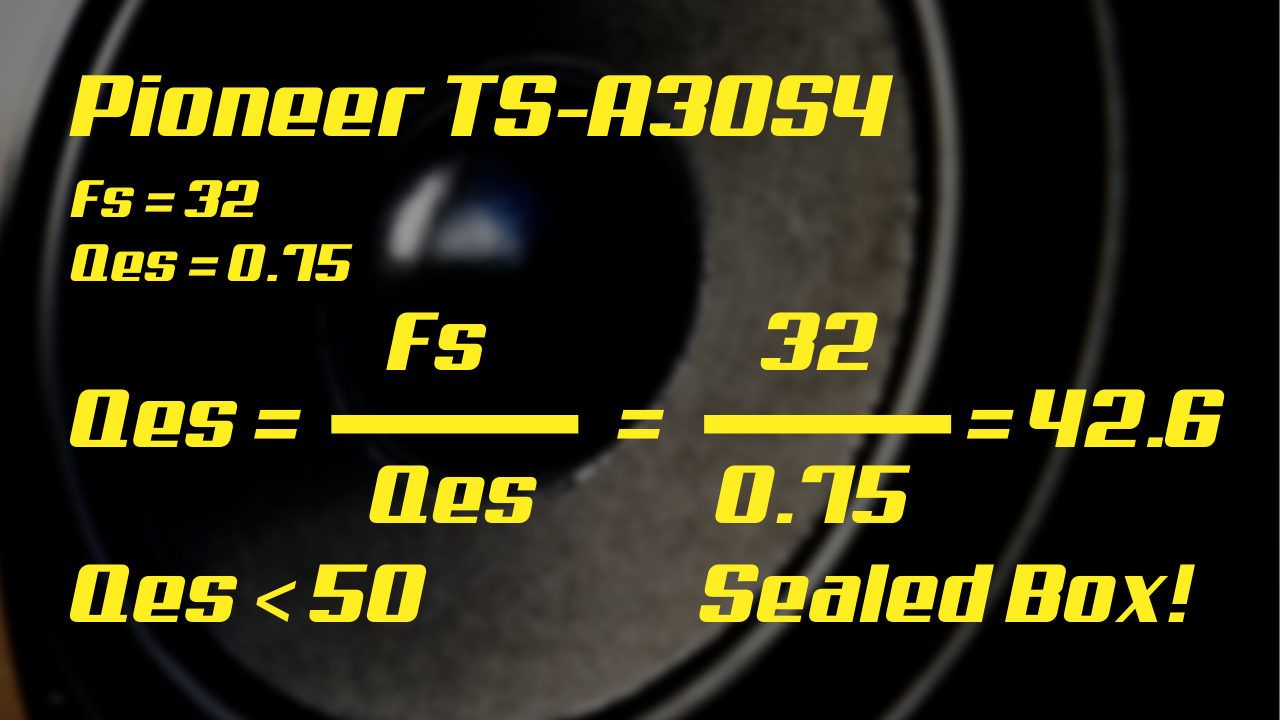
We compute Efficiency Bandwidth Product by dividing Fs by Qes.

Can you give some Examples to solve for Efficiency Bandwidth Product?

Efficiency Bandwidth Product for DS18 EXL-12.2D


Efficiency Bandwidth Product for Pioneer TS-A30S4


Efficiency Bandwidth Product for Dayton Audio Classic DCS305


Thursday, February 10, 2022